If you have an app idea sitting in your notes, there is a number you really want to know before you do anything else. How much will it cost to build the first usable version? You are not alone. In 2026, this is the single most searched question among founders, indie hackers, and product teams who are tired of guessing.
The short answer is that a Minimum Viable Product (MVP) costs anywhere from $15,000 to $150,000 in 2026, with most well scoped builds landing between $20,000 and $75,000. The long answer is more interesting, because it tells you exactly where your money goes, what you can cut without killing the product, and where AI is quietly rewriting the budget rules this year.
Let us walk through it the way we would in a real strategy call.
What Counts as an MVP in 2026 (And Why That Matters for Your Wallet)
An MVP is not a prototype. It is not a clickable Figma file. It is the leanest real product you can ship to real users so they can pay, complain, ignore you, or fall in love with what you made. That definition has not changed since Eric Ries wrote The Lean Startup. What has changed is how cheap and how fast a serious team can ship one.
In 2026, AI assisted coding, mature design systems, and battle tested open-source stacks have pushed the floor of MVP cost lower than ever. At the same time, user expectations have gone up. People who download your app today have been shaped by ChatGPT, Linear, Notion, and a thousand AI native tools. A clunky MVP gets uninstalled before lunch. That tension, lower build cost paired with higher quality expectations, is the real story of this year.
The Honest 2026 Price Ranges
Here is what real teams are quoting and delivering this year, pulled from current market benchmarks across MVP development agencies in North America, Europe, and Asia.
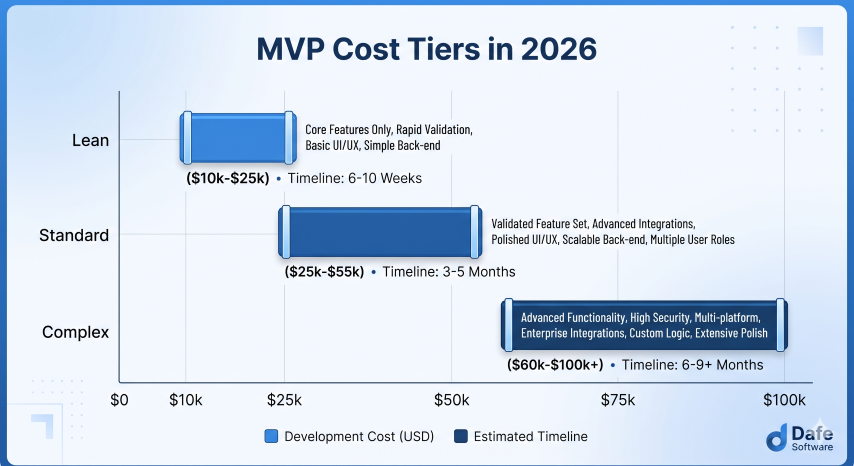
Lean MVP: $15,000 to $30,000 One or two core user flows. Web or single platform. About 6 to 8 weeks of work. Think a focused SaaS tool, a marketplace landing flow, or a vertical AI assistant for a niche audience. Good for testing one specific hypothesis with one specific group of users.
Standard MVP: $35,000 to $70,000 Three to four flows. User accounts, payments, an admin dashboard, and one or two integrations. About 10 to 14 weeks. This is where most funded startups and serious bootstrappers land. It looks and feels like a real product because it is one.
Complex or AI Powered MVP: $75,000 to $150,000+ Five or more flows, multiple platforms (iOS, Android, web), heavier integrations, custom AI features like RAG pipelines or copilots, and sometimes compliance requirements like HIPAA, SOC 2, or PCI. Three to six months of work. Higher risk, higher reward, and the right move when the product itself is the moat.
The pattern is consistent. Every feature beyond the core three to five adds roughly 10 to 20 percent to the budget. Most over budget MVPs do not fail because of bad developers. They fail because someone said yes to one too many "nice to have" features in week three.
Where Your Money Actually Goes
If you have ever received a $60,000 estimate and wondered what the line items mean, here is the breakdown that matters.
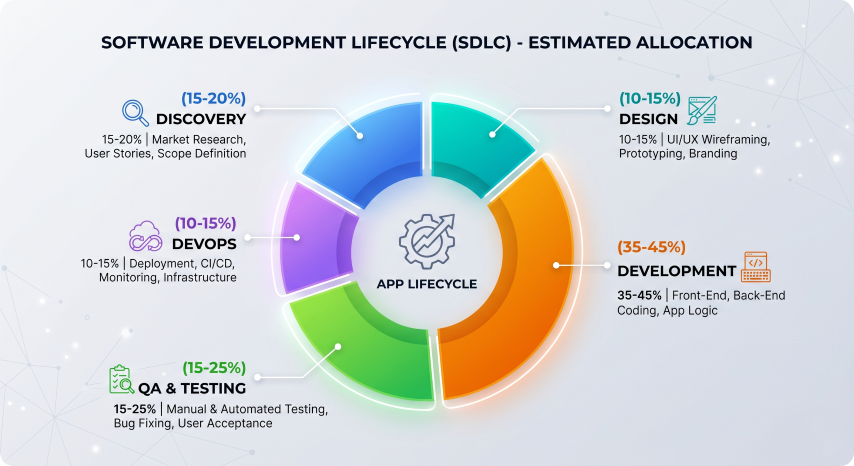
Discovery and Planning (10 to 15 percent of the budget) This is the unsexy phase that decides whether your MVP succeeds. User research, competitor analysis, feature prioritization with the MoSCoW method, technical architecture, and a written scope. Teams that spend at least 20 percent of their budget here are three times more likely to ship a product the market actually wants. Skipping this step is the most expensive mistake in software.
UX and UI Design (15 to 20 percent) Wireframes, prototypes, a design system, and the final polished screens. In 2026, a good designer is also half product strategist. They will tell you why your sign-up flow is bleeding users before a single line of code is written.
Frontend and Backend Development (45 to 55 percent) This is the heaviest line item. APIs, databases, authentication, business logic, and the screens users actually touch. The hourly rate of your developers is the biggest single variable here. More on that in a moment.
QA, Testing, and Bug Fixes (10 to 15 percent) Functional testing, usability testing, performance testing, and security checks. Skipping QA to save money is like skipping the brakes on a car to save weight.
DevOps, Deployment, and Launch (5 to 10 percent) Cloud setup on AWS, Google Cloud, or Azure. CI/CD pipelines. App store submissions. Monitoring tools. This is small as a percentage, but mission critical.
The Team Location Question (And Why It Is Not Just About Cheap Rates)
Geography is the second biggest cost driver after scope. A senior developer in the United States or Canada bills $150 to $250 per hour in 2026. The same skill level in Western Europe runs $80 to $150 per hour. Eastern Europe sits at $40 to $80. India and parts of Southeast Asia come in at $20 to $50 per hour.
On paper, a $120,000 US build becomes a $35,000 to $55,000 build with a quality offshore team. That is a real saving, and we will not pretend otherwise. But the cheapest hourly rate is not always the cheapest project. A team that miscommunicates requirements, ships untested code, or disappears after the launch will cost you twice when you have to redo the work.
The smart move in 2026 is a hybrid team. A senior product lead in your timezone who owns scope, quality, and communication, plus a strong engineering team in a cost effective region doing the heavy lifting. That model delivers US quality at 40 to 50 percent of the US price. It is the model Dafe Software runs by default.
What AI Is Doing to MVP Budgets This Year
This is the part of the conversation that has changed the most in 12 months. Two things are happening at once.
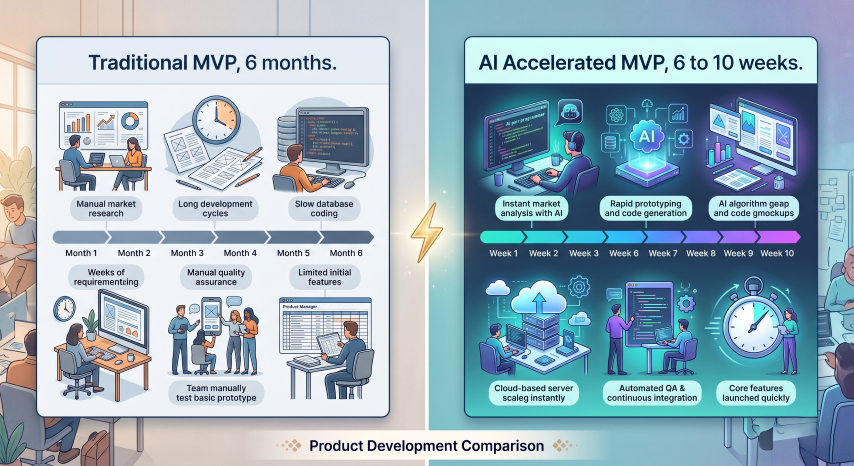
First, AI is making development faster. GitHub Copilot, Cursor, Claude Code, and similar tools are cutting routine coding time by 15 to 25 percent for experienced teams. That saving gets passed through to clients who work with teams that have actually integrated those tools into their workflow, not just bolted them on.
Second, AI features inside your MVP add cost. If your product includes a RAG pipeline, a chat copilot, custom embeddings, or any non trivial LLM feature, expect a 15 to 30 percent premium on top of a comparable non AI build. Data preparation, evaluation harnesses, prompt engineering, and guardrails are real engineering work, not a five minute API call.
No code tools like Bubble, Webflow, and FlutterFlow are also part of the conversation. You can ship a no code MVP for $5,000 to $20,000. That is real and often a smart move for early validation. The catch is the exit cost. When you hit scale, you will rebuild in custom code, and that rebuild often costs more than starting custom in the first place. The right choice depends on how confident you are in your hypothesis and how fast you need to test it.
The Hidden Costs Nobody Quotes You
This is where founders get burned. The build price you see on the proposal is not the full cost of getting to a working product in users' hands. Plan for these.
Cloud hosting runs $50 to $200 per month for a low traffic MVP and $500 to $2,000 per month once you have meaningful users. App store fees are $99 per year for Apple and $25 one time for Google. SSL certificates, domain registration, and third party tools like Stripe, Twilio, SendGrid, Auth0, and analytics tools add up to a few hundred dollars per month. Legal work for Terms of Service, Privacy Policy, and basic IP protection runs $1,500 to $5,000 if done properly. Maintenance after launch typically runs 15 to 20 percent of the build cost per year. For a $60,000 MVP, that is $9,000 to $12,000 per year in upkeep, security patches, and small improvements.
Add it all up and the real first year cost of an MVP is usually 20 to 40 percent higher than the build quote. Any agency that does not walk you through this is either inexperienced or hiding something.
How to Actually Reduce the Cost Without Wrecking the Product
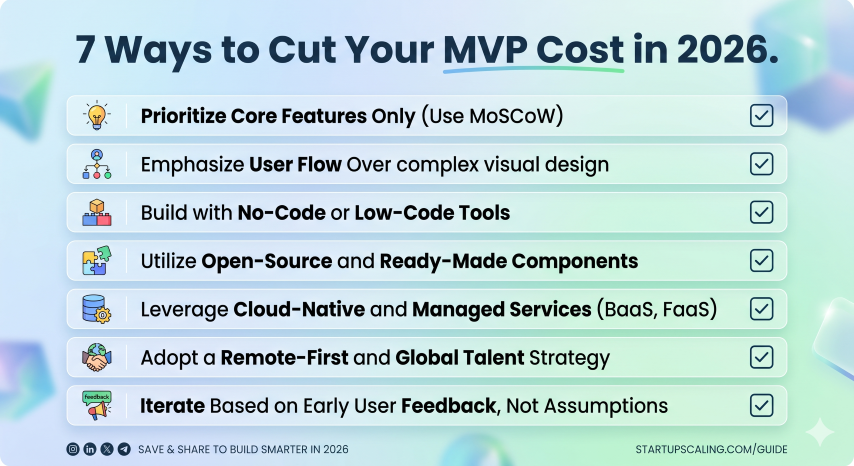
There are ways to cut your MVP cost by 30 to 50 percent that do not involve buying junk. Here are the moves that work.
Spend two weeks and a small budget on discovery before you write a single line of code. Founders who do this save $20,000 to $50,000 in rework. Use the MoSCoW method to slash your feature list to what is truly Must Have for the first launch. Lean on open source and pre built modules instead of building everything from scratch. Use cloud startup credits from AWS, Google Cloud, and Azure to push hosting costs near zero for the first year. Build with a cross platform framework like Flutter or React Native if you need both iOS and Android. Hire a hybrid team with a senior product owner in your region and engineers in a cost effective region. Phase your MVP into a micro MVP first (one core hypothesis, 4 to 6 weeks) and a second version that builds on real user feedback.
None of these are hacks. They are how serious teams ship serious products on lean budgets in 2026.
A Realistic Example: What a $45,000 MVP Looks Like in 2026
Let us make this concrete. A SaaS founder comes to us with an idea for a small business invoicing tool with built in AI categorization of expenses. Here is roughly how the budget breaks down for a Standard MVP in this range.
Discovery and scope: $5,000. Two weeks of user interviews, competitor analysis, scope document, and architecture. Design: $7,500. A clean design system, fifteen polished screens, a clickable prototype. Development: $25,000. Web app with Stripe payments, Postgres database, an admin dashboard, and an OpenAI powered expense categorization feature. QA and testing: $4,500. Functional and usability testing across desktop and mobile web. DevOps and launch: $3,000. AWS setup, CI/CD pipeline, monitoring, and production deployment.
Total: $45,000. Timeline: 12 weeks. Outcome: a real product in real users' hands, with the data to either raise the next round or pivot fast.
That is what a thoughtful, modern MVP looks like in 2026. Not a $200,000 marathon. Not a $5,000 disposable prototype. A real, shippable product built for the way the market actually works today.
Why This Matters for Your Decision Right Now
Every week you spend not building is a week your idea sits in your head while someone else ships theirs. The longer you wait, the more expensive validation becomes, because the market moves faster than your roadmap.
The teams that win in 2026 are not the ones with the biggest budgets. They are the ones who scope smart, ship fast, learn from real users, and iterate. That is a process, not a price tag. And the right development partner is the one who treats your budget like their own and your timeline like a deadline that actually matters.
Build Your MVP With Dafe Software
At Dafe Software, we have spent the last several years helping founders go from blurry idea to shipped product without burning through a seed round. We work as a hybrid team, write production grade code, integrate AI properly when it makes sense, and tell you the truth about scope, cost, and timeline before you sign anything.
If you are ready to stop pricing this in your head and start building, here is what to do next.
Book a free 30 minute MVP strategy call with our team. We will walk through your idea, identify the smallest version that can prove the hypothesis, and give you a real number, a real timeline, and a real plan. No fluff, no upselling, no surprise invoices.
Your MVP is closer and cheaper than you think. Let us help you ship it.
Contact Dafe Software today and turn that idea in your notes into the product your users have been waiting for.
Dafe Software is a full-service MVP development partner specializing in AI native, scalable, founder friendly product builds. We work with startups, agencies, and innovation teams across North America, Europe, and Africa.
 By
By 
 MVP Development