If you have ever sat down with a notebook full of product ideas and felt your stomach turn at the thought of how much money, time, and risk a full build would cost, you are not alone. Most founders we talk to at Dafe Software arrive with the same quiet fear. They have a strong idea, a target market in mind, and a calendar that is already moving faster than their bank account. What they need is a way to test reality without betting the farm. That is exactly what a Minimum Viable Product, more commonly called an MVP, was designed to do.
This guide breaks down what an MVP actually is, why it matters, how it works, the mistakes that kill startups before they ship, and how to make sure your first version becomes a launchpad instead of a liability.

The Real Definition of a Minimum Viable Product
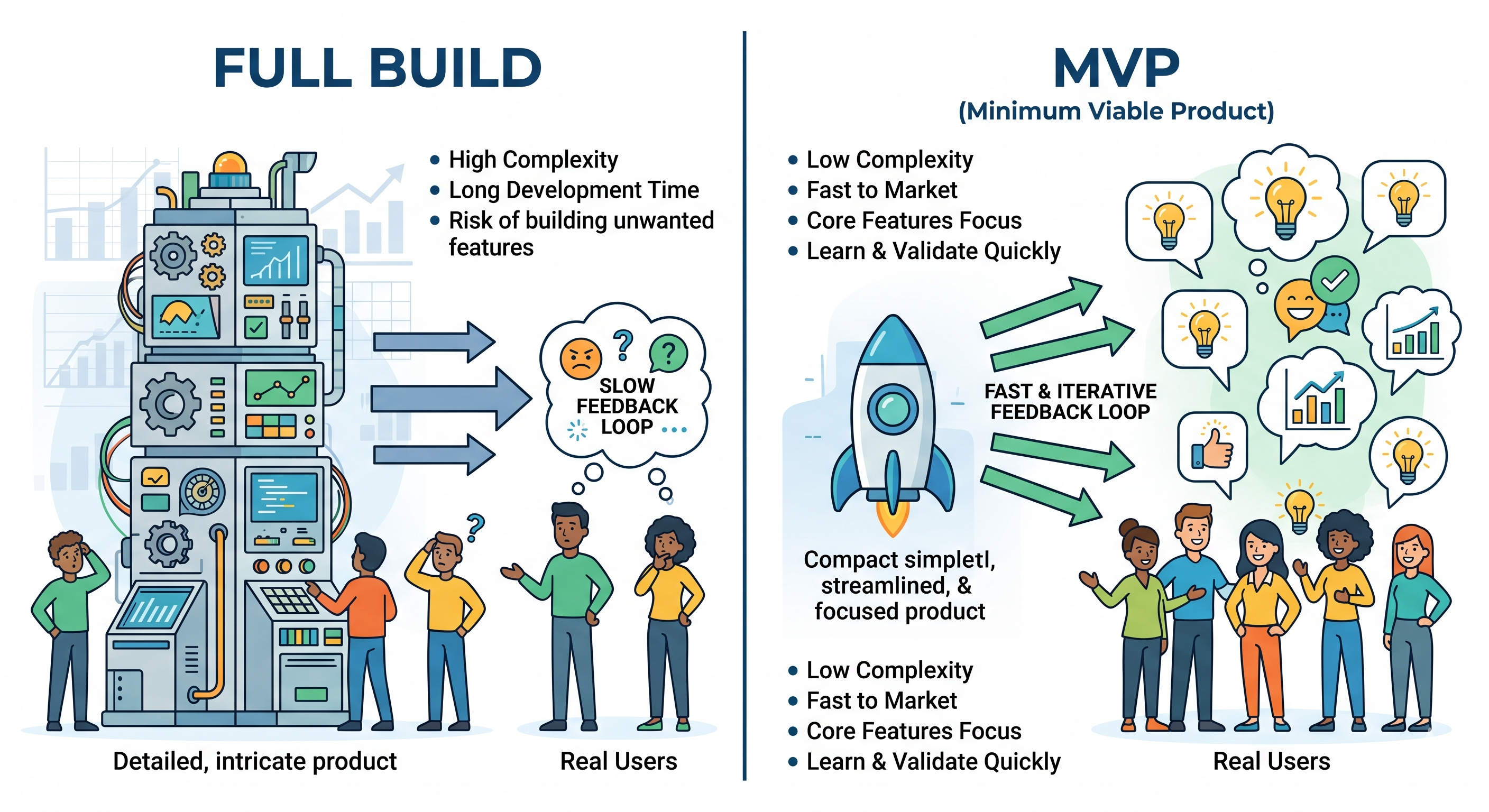
A Minimum Viable Product is the simplest working version of your product that can deliver real value to a specific user, gather honest feedback, and validate whether your idea deserves more investment. It is not a prototype. It is not a demo. It is a real product, just stripped down to its sharpest edge.
The term was popularized by Eric Ries in The Lean Startup, but the philosophy behind it stretches back to every smart business owner who ever tested a single recipe before opening a full restaurant. The MVP is a learning tool disguised as a product. Its job is not to impress investors with polish. Its job is to answer one brutal question. Do real people actually want this enough to use it, pay for it, or stick with it?
If your product cannot answer that question, no amount of design polish, marketing budget, or feature stuffing will save it.
Why MVPs Matter More Than Ever in 2026
The cost of building software has dropped, but the cost of building the wrong software has gone up. Users have more options, attention spans are thinner, and competitors can copy a polished feature in weeks. Launching a bloated v1 today is like showing up to a sprint carrying luggage. You lose before you start.
An MVP gives founders five things that a full build cannot.
First, it shortens the distance between idea and evidence. You stop guessing and start measuring. Second, it protects your capital so you can survive long enough to find product market fit. Third, it builds a real user base early, which means honest feedback instead of imagined user personas. Fourth, it makes fundraising easier because traction beats slides every time. Fifth, it keeps your team focused on what matters, which is the smallest set of features that proves your value.
Most startups do not die because they ran out of ideas. They die because they ran out of runway while building features no one asked for.
What an MVP Is Not
This is where most founders get tripped up. An MVP is not a half finished product. It is not a buggy, embarrassing version of your full vision. And it is not an excuse to launch something that does not work.
A good MVP is functional, focused, and feels intentional. The features it has should work well. The features it does not have should not be missed by your target user during the first thirty days. If a user opens your MVP and walks away confused or frustrated, you have not launched an MVP. You have launched a problem.
A strong way to think about it comes from Henrik Kniberg's famous skateboard analogy. If your goal is to give someone transportation, you do not deliver a single wheel, then two wheels, then a chassis, then a finished car. You deliver a skateboard first, then a scooter, then a bicycle, then a motorbike, then a car. Each version is whole. Each version is useful. Each version teaches you something the next version needs.
The Different Types of MVPs Founders Should Know
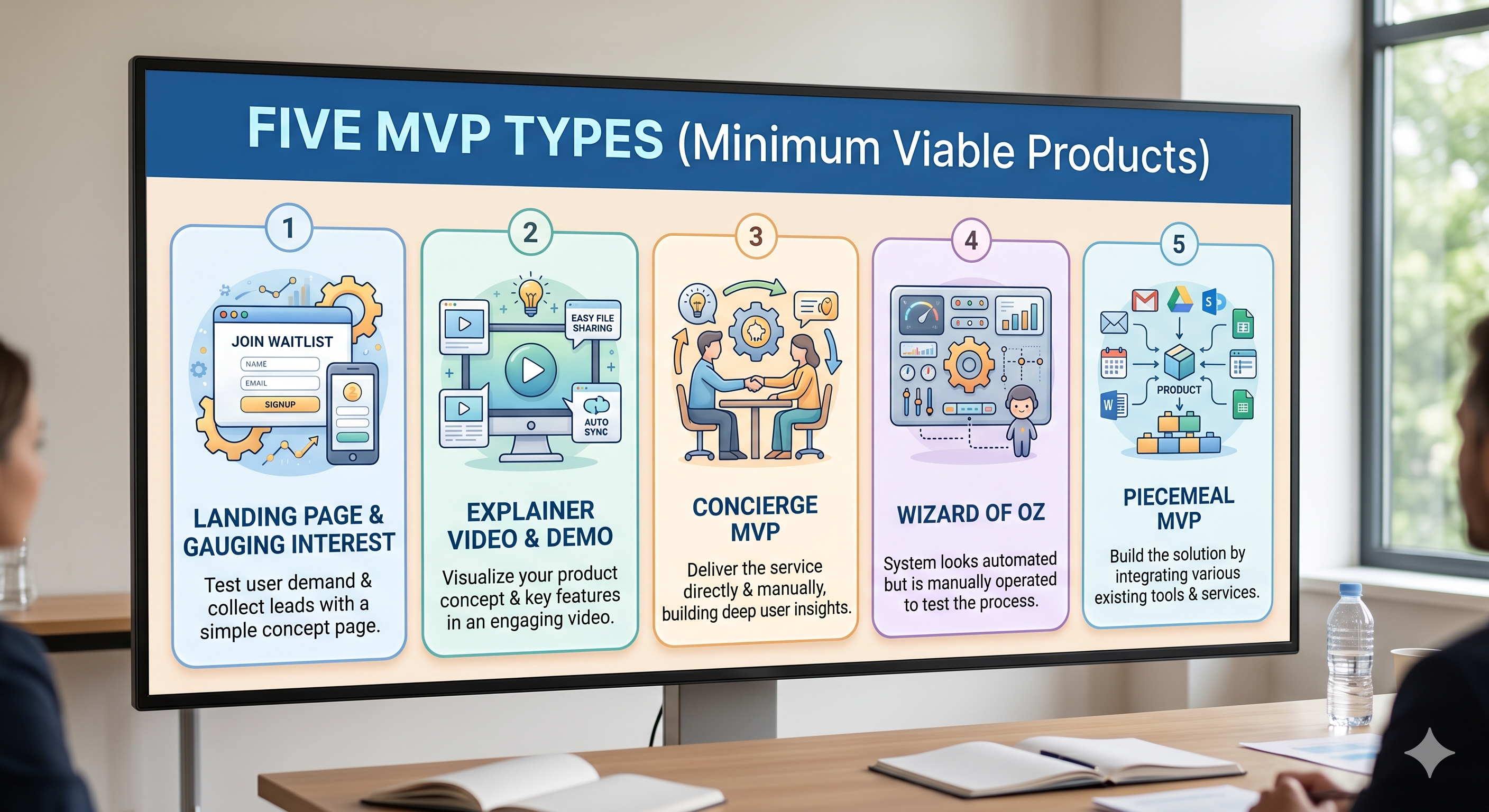
Not every MVP needs to be a fully coded app. Depending on your idea, budget, and stage, one of these flavors might fit better.
The landing page MVP is a single web page that explains your product and invites visitors to sign up, pay a deposit, or join a waitlist. It tests demand before a line of code is written. Buffer famously did this and got hundreds of signups before building anything.
The concierge MVP is when you deliver the service manually behind the scenes while the user thinks they are using software. It is brilliant for validating workflows. Many fintech and AI products started this way.
The Wizard of Oz MVP looks like real software on the front end but has a human pulling the levers in the back. Zappos did this by photographing shoes in local stores and shipping them by hand before building any logistics technology.
The single feature MVP is the most common in software. You build the one feature that solves the sharpest pain point. Instagram launched as a simple photo filter and sharing app. Twitter started as a basic status update tool. Both grew into ecosystems, but neither launched as one.
The piecemeal MVP is built using existing tools stitched together. Think Zapier, Airtable, no code platforms, and off the shelf APIs. It is fast, cheap, and surprisingly effective for early validation.
The right choice depends on what you need to learn. The wrong choice wastes months you do not have.
How to Build an MVP That Actually Converts Users
Building an MVP is less about coding and more about thinking. Here is the path our team at Dafe Software walks every founder through.
Start by identifying the core problem. Write it down in one sentence. If you cannot describe the pain in plain language, your users will not feel the relief.
Next, define your ideal early adopter. Not your dream customer. The person who has the problem so badly they would try a rough product if it promised relief. This is the audience that gives you the truest signal.
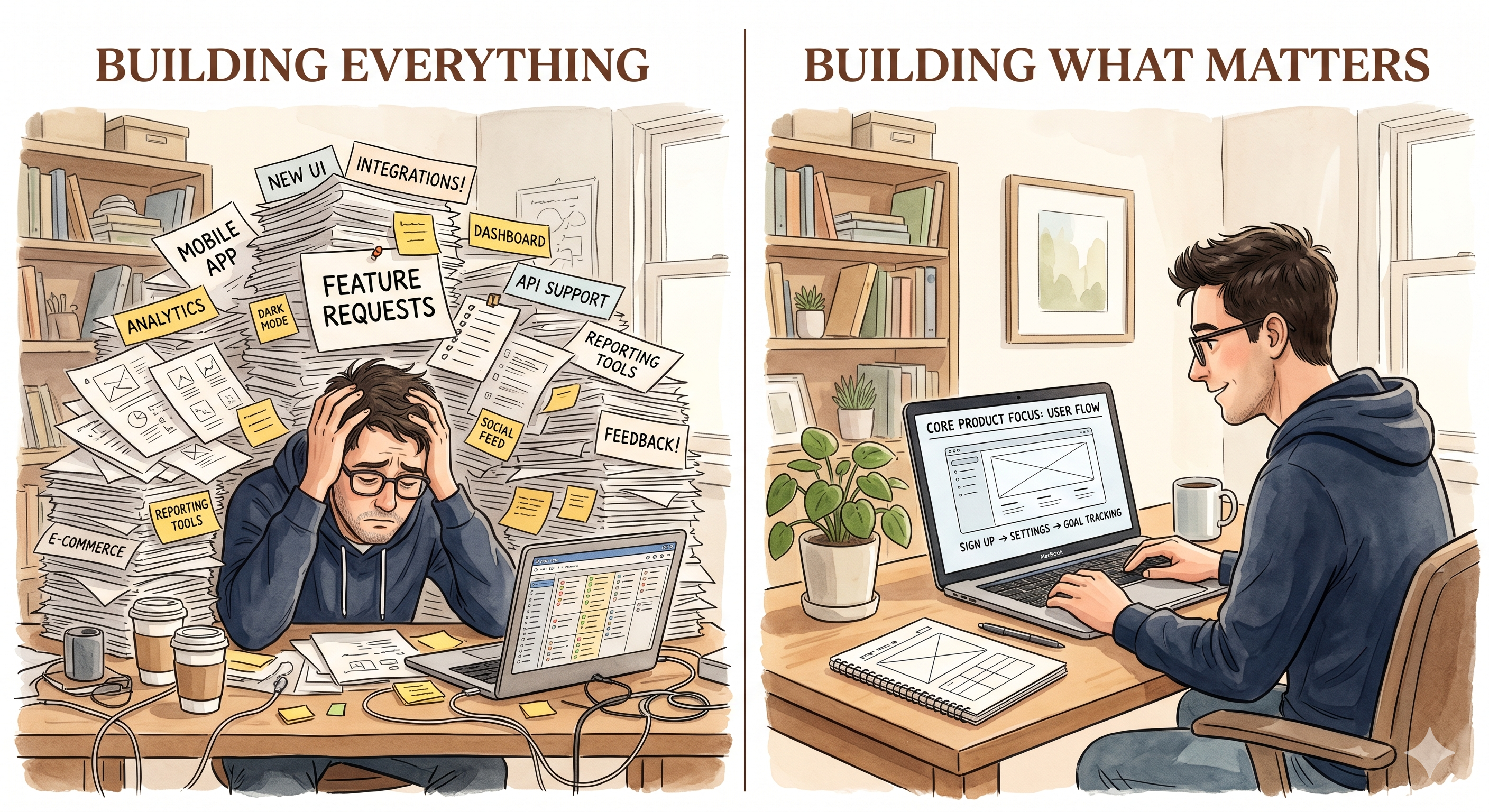
Then map the user journey. What is the smallest sequence of actions that takes someone from problem to solution inside your product? Cut everything that is not part of that sequence. If a feature is not on the path to value, it does not belong in the MVP.
Pick your success metrics before you build. Activation rate, retention at day seven, conversion from free to paid, weekly active users, whatever fits your model. If you do not know what success looks like, you will not recognize it when it arrives, and you will not recognize failure either.
Build, ship, learn, and adjust. The build and ship phase should be measured in weeks, not quarters. Anything longer than ten to fourteen weeks for a first version usually means scope has crept in.
This is where having experienced engineers matters more than founders often realize. A skilled MVP team will push back on unnecessary features, suggest faster paths, and protect you from the technical decisions that haunt startups two years later when they try to scale.
The Mistakes That Kill MVPs Before They Launch
We have audited dozens of MVPs that failed, and the same patterns show up over and over.
Founders fall in love with the product instead of the problem. They keep adding features that excite them but confuse users. They skip user interviews because they are afraid of bad news. They build for investors instead of customers. They confuse polish with progress. They wait for the perfect launch moment that never arrives. And they treat the MVP as a finish line instead of the starting block it actually is.
The hardest lesson to swallow is this. Your MVP should embarrass you a little when it launches. If it does not, you waited too long.
How Real Companies Used MVPs to Become Giants
Dropbox launched with a three minute video demonstration before any working software existed. It tested whether anyone wanted the product. Hundreds of thousands of people signed up overnight, which gave the founders the conviction and the capital to build the real thing.
Airbnb began with three air mattresses in a San Francisco apartment and a website that looked like a college project. The founders manually photographed listings and handled bookings. They did not build a marketplace. They proved one.
Facebook started inside a single university with no mobile app, no news feed, no marketplace, no advertising platform. Just a profile and a friend connection. It was painfully simple, and it worked because the problem it solved was real.
The pattern is consistent. Start narrow. Validate ruthlessly. Expand when the evidence demands it.
When to Scale Beyond Your MVP
Knowing when to stop being an MVP is just as important as building one. The signals are clear when you know what to look for. Users come back without being prompted. Retention curves flatten instead of dropping to zero. People refer their friends without you asking. Customer support starts hearing the same upgrade requests. Revenue or engagement begins to grow without paid marketing carrying it.
When those signs appear, it is time to invest in scale. That means hardening the codebase, building for performance, adding the features your validated audience is actually pulling out of you, and preparing the infrastructure for ten times the load.
This is the moment where the wrong technical foundation becomes very expensive. MVPs built by inexperienced teams often need to be rewritten entirely at this stage, which costs founders' months and sometimes their entire fundraising round. MVPs built by experienced teams scale into v2 without a teardown.
Why Founders Trust Dafe Software to Build Their MVP
At Dafe Software, we have helped founders across fintech, health, e-commerce, education, logistics, and AI launch MVPs that actually moved the needle. We do not build features for the sake of features. We build products that prove ideas, win first users, and survive the jump to scale.
Every engagement starts with the same promise. We will challenge your assumptions, sharpen your scope, build only what your earliest users need, and ship in a window that protects your runway. Then we will help you read the signals, iterate fast, and grow into the product your market is asking for.
If you have an idea that keeps you up at night, you do not need a six-month build. You need an MVP that learns fast, costs smart and gives you the evidence to keep going.
Book a free MVP discovery call with Dafe Software today. Bring your idea, your questions, and your honest budget. We will tell you what is possible, what is not, and the smartest path from where you are to a product real users love.
Your idea deserves more than a slide deck. Let us help you ship it.
 By
By 
 MVP Development