If you have ever asked a developer, "How long will it take to build my SaaS?" you probably got the same answer twice in a row, just worded differently. "It depends." That is technically true, but it is also the kind of answer that keeps founders stuck for weeks. So let us replace it with something more useful.
In 2026, the honest range for a custom SaaS platform sits between 8 weeks and 28 weeks, with the average lean MVP landing somewhere around 12 to 16 weeks. Larger, multi-tenant, compliance heavy platforms can stretch to 9 or 12 months. The shift this year is real though. AI assisted coding, mature component libraries, and tighter scoping practices have compressed timelines by roughly 15 to 25 percent compared to two years ago, according to recent industry reports from Technijian and RaftLabs.
Below is a clean breakdown of what those weeks actually look like, what makes them stretch, and how to get a fast, no nonsense estimate for your own idea.
The Short Answer First
Here is the rough map most experienced SaaS shops, including ours at Dafe Software, work from in 2026:
A simple SaaS MVP with three to five core features usually takes about 6 to 10 weeks. A standard, market ready SaaS product takes 12 to 16 weeks. A complex platform with multi tenancy, role based access, payments, third party integrations, and AI features sits around 20 to 28 weeks. Anything enterprise grade with strict compliance, audit logs, and high traffic readiness can run 9 to 12 months or longer.
If you want a tailored number based on your exact features, you can skip the guesswork and use the MVP Cost Calculator - Dafe Software. It gives you a personalized estimate in about two minutes.
What Actually Happens in Those Weeks
A SaaS build is not one big block of "coding." It is five distinct stages, and each one consumes a predictable slice of the calendar.
1. Discovery and Product Definition (1 to 3 weeks)
This is where most founders try to save time, and where the schedule usually breaks later. Discovery is the phase where you nail down who the platform serves, what the core jobs to be done are, what features ship in v1, and what is deliberately cut. A clean, signed off scope reduces the rest of the build by 30 to 40 percent. A vague one quietly inflates it.
Deliverables you should expect at the end of discovery include a product requirements document, a feature priority map, a rough architecture sketch, and a fixed timeline with clear assumptions.
2. UX and UI Design (2 to 4 weeks)
This phase covers user flows, wireframes, a clickable prototype, and the final UI system. Modern teams in 2026 lean heavily on design systems like shadcn, Untitled UI, and AI assisted Figma plugins, which means design moves faster than it used to. A founder who can make decisions inside 48 hours can shave a full week off this stage.
3. Development (4 to 16 weeks)
This is the longest block. Modern SaaS development runs in two week sprints. At the end of each sprint, you should see working software in a staging environment, not slides or status updates. The work itself splits across:
Frontend build, backend services, database design, authentication and user management, billing and subscriptions, admin dashboards, and any AI features or integrations.
This is also where AI assisted coding moves the needle. Teams using tools like Cursor, Claude Code, and GitHub Copilot ship features 40 to 60 percent faster on the implementation step, although the overall project timeline only drops 15 to 25 percent because discovery, design, QA, and review still take human time.
4. QA, Security, and Hardening (1 to 3 weeks)
Automated tests, manual QA, security checks, performance tuning, and accessibility passes. Skipping this stage is the single most expensive shortcut a founder can take. It is also where most "we will fix it after launch" promises quietly become twelve months of technical debt.
5. Launch and Stabilization (1 to 2 weeks)
Production deployment, monitoring, analytics, onboarding flows, and the first round of real user feedback. Most teams keep a small reserve of hours here for the inevitable "small thing" that always shows up in week one.
What Makes a SaaS Build Take Longer Than Expected
The honest list, based on what slows real projects down:
Unclear scope at kickoff is the number one culprit. Every new "small idea" added mid sprint costs more than it looks like it should. Slow stakeholder feedback is the second. A 48 hour review cycle is healthy. A 7 day one quietly adds weeks. Heavy integrations with legacy systems, payment processors with strict KYC, or specialty APIs each add roughly 2 weeks per integration. Compliance requirements such as HIPAA, SOC 2, or GDPR add 2 to 4 weeks of dedicated work. Multi tenancy decisions made late, rather than at the architecture stage, can force partial rewrites.
The opposite is also true. Founders who arrive with a clear written brief, decisive feedback habits, and a willingness to defer non essential features routinely launch ahead of schedule.
How AI Changed SaaS Timelines in 2026
This is the part most older blog posts get wrong, so it is worth saying plainly. AI did not turn a 16 week build into a weekend project. What it did was shift the bottleneck. The hard part is no longer "can we write this code." It is "can you describe what you want clearly enough."
For founders, that means the value of a sharp product brief has gone up, not down. The teams that move fastest in 2026 are the ones that pair a focused founder with a development partner who already has battle tested SaaS boilerplates, AI workflows, and a track record of shipping inside the quoted window.
By the end of 2026, around 40 percent of new enterprise SaaS products are expected to ship with task specific AI agents built in. If your platform is going to compete in that landscape, baking AI features into your MVP rather than bolting them on later is now the default move.
A Realistic 12 Week SaaS Build, Week by Week
Here is what a typical lean SaaS MVP timeline looks like at Dafe Software when the founder is decisive and the scope is well defined:
Weeks 1 and 2 cover discovery, requirements, and a signed scope.
Weeks 3 and 4 cover UX flows, wireframes, and a clickable prototype.
Weeks 5 through 9 cover core development across frontend, backend, auth, billing, and the first integrations.
Weeks 10 and 11 cover QA, security, and performance hardening.
Week 12 covers production launch, analytics, and onboarding polish.
This pace is realistic because we are not inventing the boring parts every time. Auth, billing, role management, admin panels, and deploy pipelines come from hardened internal templates. Your team should be spending its expensive hours on the parts that make your product different, not on rebuilding login screens.
So, What Should You Do Next?
If you are in the early phase of planning a SaaS product, three moves will save you the most time and money.
First, write a one page brief. Who is the user, what is the core job, what are the must have features for v1, and what gets cut. Second, decide whether you want a fixed scope MVP or a longer build to a larger v1. Third, get a real number on the table so you can plan your runway with eyes open.
The fastest way to do that last step is to use the MVP Cost Calculator - Dafe Software. You answer a short set of questions about your product, and you get a clear estimate of timeline and cost, with no sales call required to see the number.
If your idea is more complex than a calculator can capture, or you want a human to pressure test your scope, you can book a free scoping session with our team straight from the same page. We will tell you honestly whether your timeline expectation is realistic, where the risk areas are, and what your fastest path to launch looks like.
The Bottom Line
In 2026, building a custom SaaS platform is faster than it has ever been, but the projects that finish on time still share the same three traits. A clean scope. Decisive founders. A team that has shipped products like yours before.
If you have the first two, we can almost always help with the third. Get your custom estimate with the MVP Cost Calculator - Dafe Software and turn "it depends" into a real number you can plan around.
 By
By 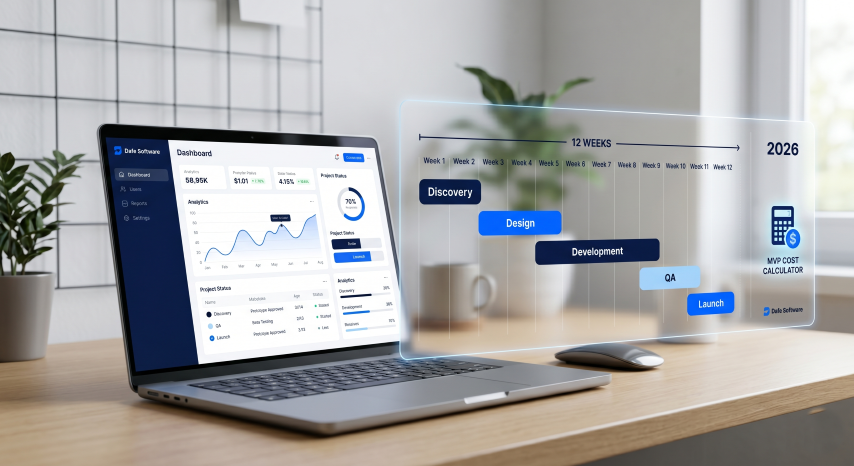
 Custom Software Development