You have the idea. You have the energy. You probably have a Notion doc, a Figma sketch, and three voice notes from the shower where you almost cracked the entire business model.
What you do not have is the technical team.
So you open Upwork. You post on Toptal. You message a friend of a friend who "builds apps." And then you stare at a wall of profiles, hourly rates, and five-star reviews, and you start wondering if this is really the right way to bring your MVP to life.
Here is the part most founders learn the hard way. The cheapest way to start your MVP is almost always the most expensive way to finish it. A freelancer can write code. A technical partner can build a company. Those two things are not the same, and confusing them is one of the most common reasons MVPs stall, ship broken, or never raise a dime after launch.
This post breaks down what really separates a freelancer from a technical partner, why the difference matters more than your budget, and how to know which one your MVP actually needs. If by the end you want to skip the guesswork and get a realistic build estimate, you can use the MVP Cost Calculator from Dafe Software to see what your idea would cost in time, scope, and money.
The Real Job of an MVP Is Not What You Think
Most founders describe their MVP as a "smaller version of the product." That definition is not wrong, but it is incomplete, and that gap is exactly where freelancers tend to fall short.
An MVP is not a small product. It is a learning instrument. Its real job is to answer the most dangerous question your business is facing right now. Is anyone willing to pay for this. Will users come back. Can we acquire them affordably. Will the workflow actually save the time we promised.
A freelancer treats your MVP like a ticket. You give them a spec, they give you a build. A technical partner treats your MVP like a hypothesis. They help you decide what to build, what not to build, and which feature will give you the strongest signal that the business is real.
That single shift changes everything that happens next.
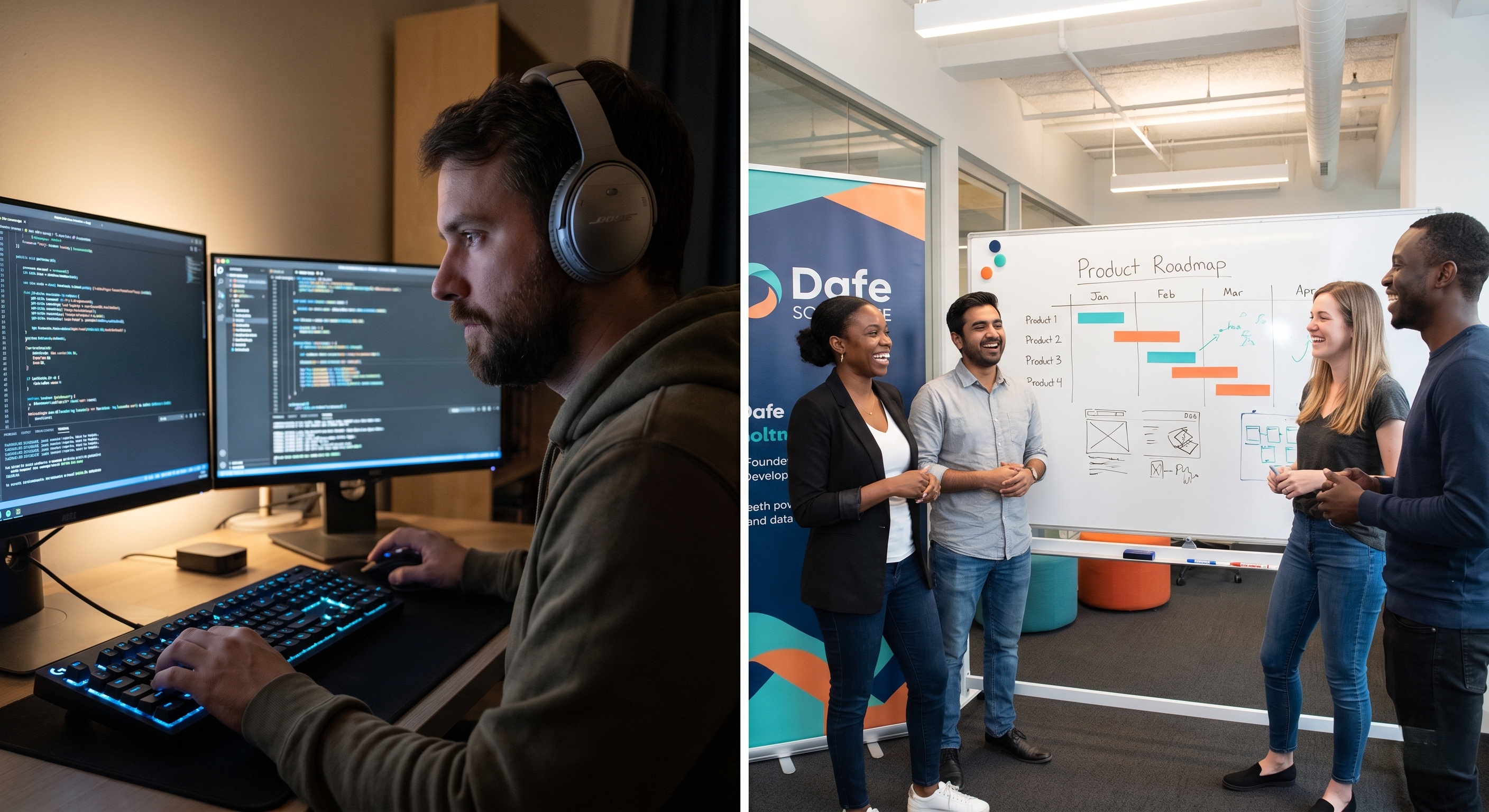
Freelancer vs Technical Partner: The Difference That Quietly Kills MVPs
On paper, they can look identical. Both write code. Both ship features. Both send invoices. The differences only show up when something goes wrong, and in early stage software, something always goes wrong.
A freelancer is hired to execute a defined task. Their incentive is to finish the scope they were paid for. If the scope is wrong, the build is still wrong. They will often deliver exactly what you asked for, even when what you asked for is not what your users need.
A technical partner is hired to share the outcome.
Their incentive is your launch, your traction, and your next round. They push back on bad scope. They flag risky assumptions. They architect the product so that version two does not require throwing version one in the trash.
Think about it like this. A freelancer is a session musician. They show up, play the notes on the page, and go home. A technical partner is the producer. They are in the room when you are writing the song, and they are still there when you are mastering the final mix.
For a side project, you want a session musician. For a company you are betting years of your life on, you want a producer.
What a Technical Partner Actually Brings to Your MVP
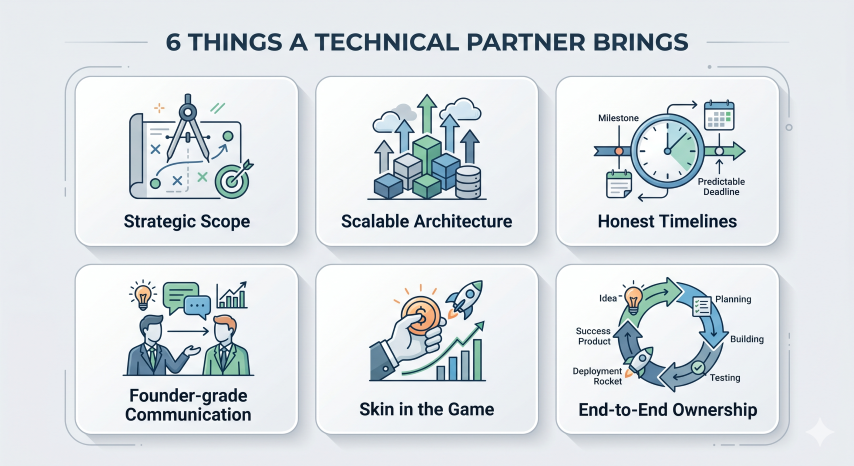
The phrase "technical partner" gets thrown around so much it has almost lost meaning. So let us be specific. When founders work with a real technical partner, they get six things that freelancers almost never provide.
Strategic scope shaping. A technical partner will challenge your feature list before they write a single line of code. They will help you cut the MVP down to the smallest version that can still prove the business. Most founders overbuild by forty to sixty percent on their first attempt. A partner saves you from that.
Architecture that survives growth. Freelancers often choose the stack they are fastest in, not the stack your business needs. A partner picks tools based on where you are heading, not just where you are. That means the auth system, the database schema, and the deployment pipeline can grow with you instead of being ripped out at the worst possible moment.
Honest timelines. A freelancer says "four weeks" because that is what you want to hear. A partner gives you a range, names the risks, and updates the plan as reality kicks in. You will know what is on track and what is slipping, every week, without having to ask twice.
Founders-grade communication. When you raise money, talk to enterprise customers, or hire your first engineer, the questions get sharper. A technical partner can sit in on investor calls, translate your roadmap into engineering language, and write the technical sections of a pitch deck without flinching. A freelancer usually cannot.
Skin in the game. Partners care about your launch metrics, your retention, and your runway. They will suggest things that do not earn them more hours, because what they really want is for you to come back for version two and version three.
End to end ownership. Design, frontend, backend, DevOps, QA, security review, app store submission, analytics setup. A partner owns all of it. With freelancers, you become the project manager whether you wanted that job or not. Spoiler. You did not want that job.
The Hidden Costs of the Freelancer Route
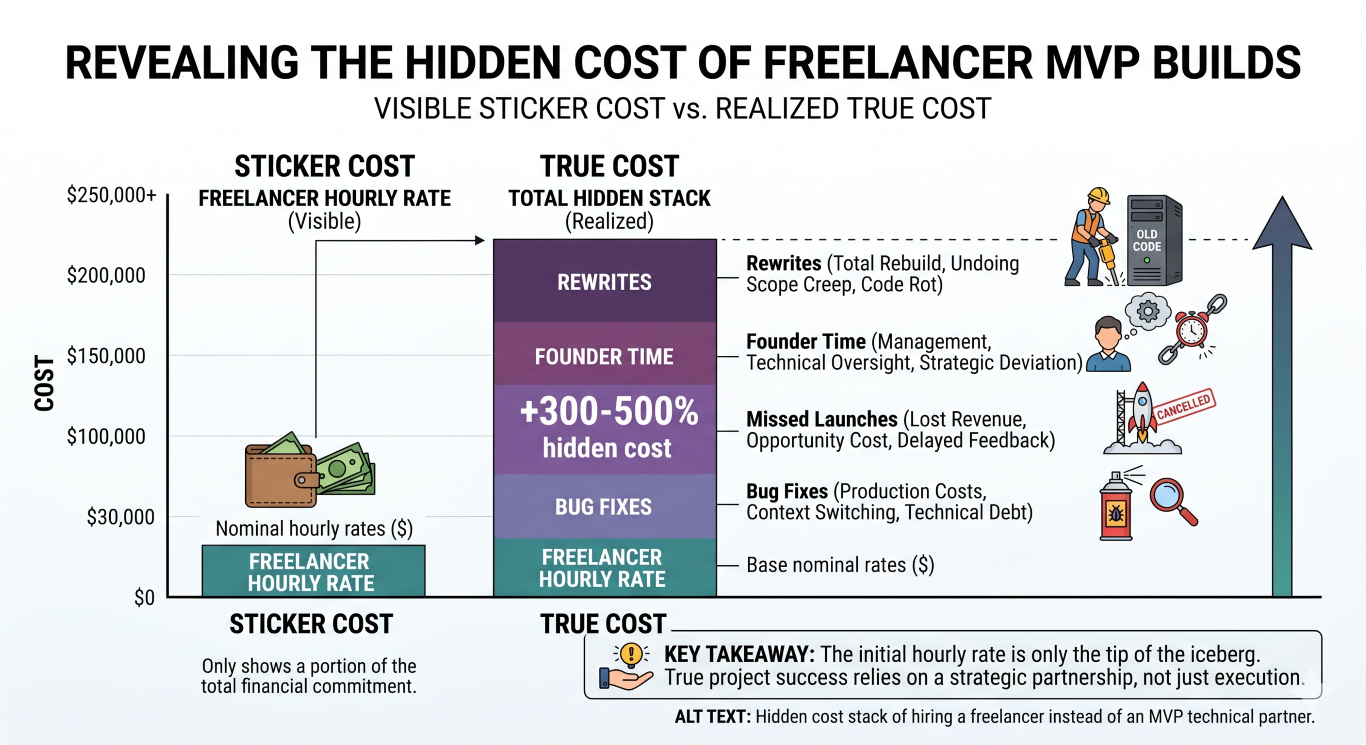
Founders rarely compare freelancers and technical partners on full cost. They compare hourly rates. That comparison is a trap.
When you hire a freelancer, you are also signing up to be the unpaid CTO. You write the specs. You manage the timeline. You review the code, even though you may not be able to read it. You handle handoffs when one freelancer disappears and another one has to pick up where they left off. You absorb the rewrite when the first version cannot scale. You eat the delay when a launch slips because nobody owned the deployment.
Add those up and the "cheap" build can easily run two or three times the cost of working with a partner from day one. That is before you count the cost of missed launch windows, lost investor momentum, and the founder burnout that comes from trying to manage what you were never trained to manage.
Worse, when something breaks after launch, there is often no one to call. Freelancers move on. Code goes unmaintained. Bugs pile up. The product that was supposed to prove your business ends up proving the wrong thing.
When a Freelancer Actually Is the Right Call
To be fair, a freelancer is the right answer in a few real scenarios.
If you already have a strong technical co-founder, and you just need extra hands on a well defined task, a freelancer is great. If you are building a landing page, a simple form, or a quick prototype that no one will ever pay for, a freelancer is great. If you have shipped MVPs before, know exactly what you want, and have the bandwidth to manage delivery yourself, a freelancer can absolutely do the job.
If none of those describe you, you do not need a freelancer. You need a partner.
How to Spot a Real Technical Partner
Not every agency or studio calling itself a "technical partner" actually is one. Here is what to look for before you sign anything.
They ask more questions than you do in the first call. They want to understand your users, your business model, and your six month plan, not just your feature list. They have shipped MVPs in your category before, and they can show you what happened after launch, not just screenshots of the launch itself. They bring a clear process for discovery, design, and engineering, and they can explain it without buzzwords. They are willing to push back on you. If a vendor agrees with everything you say in the sales call, run.
They quote in ranges, not single numbers, and they explain the assumptions behind those ranges. They include design, QA, and post launch support in the proposal, not as surprise add ons. They tell you what they will not do, as clearly as they tell you what they will.
If a team checks those boxes, you are not hiring a freelancer with a fancier invoice. You are hiring a partner.
Your MVP Is a One Shot. Treat It Like One.
Most founders only get one real swing at their first MVP. The runway, the investor attention, the energy, the focus. None of it is infinite. If the first version is built on rushed scope, fragile architecture, and a developer who is already mentally on their next contract, you do not just lose a project. You lose months of momentum that you cannot buy back.
The founders who succeed are rarely the ones who saved the most on the build. They are the ones who picked the right team early, shipped a focused MVP, learned fast, and put themselves in a position to raise, hire, or grow on their own terms.
That is what a real technical partner is for.

Ready to See What Your MVP Actually Costs?
If you have read this far, you are probably done with vague quotes and ten page proposals that say nothing. Good. So are we.
At Dafe Software, we partner with founders to scope, design, build, launch, and scale MVPs that are built to prove a business, not just tick a feature list. Before you talk to anyone, you can get a clear, no pressure estimate of what your build would actually look like.
Try the MVP Cost Calculator from Dafe Software and get a realistic breakdown of timeline, scope, and investment in under three minutes. No sales call required. Once you have the numbers, you will have a much sharper conversation with whoever you hire next, even if it is not us.
Your MVP deserves a partner who is in it with you. Start there.
 By
By 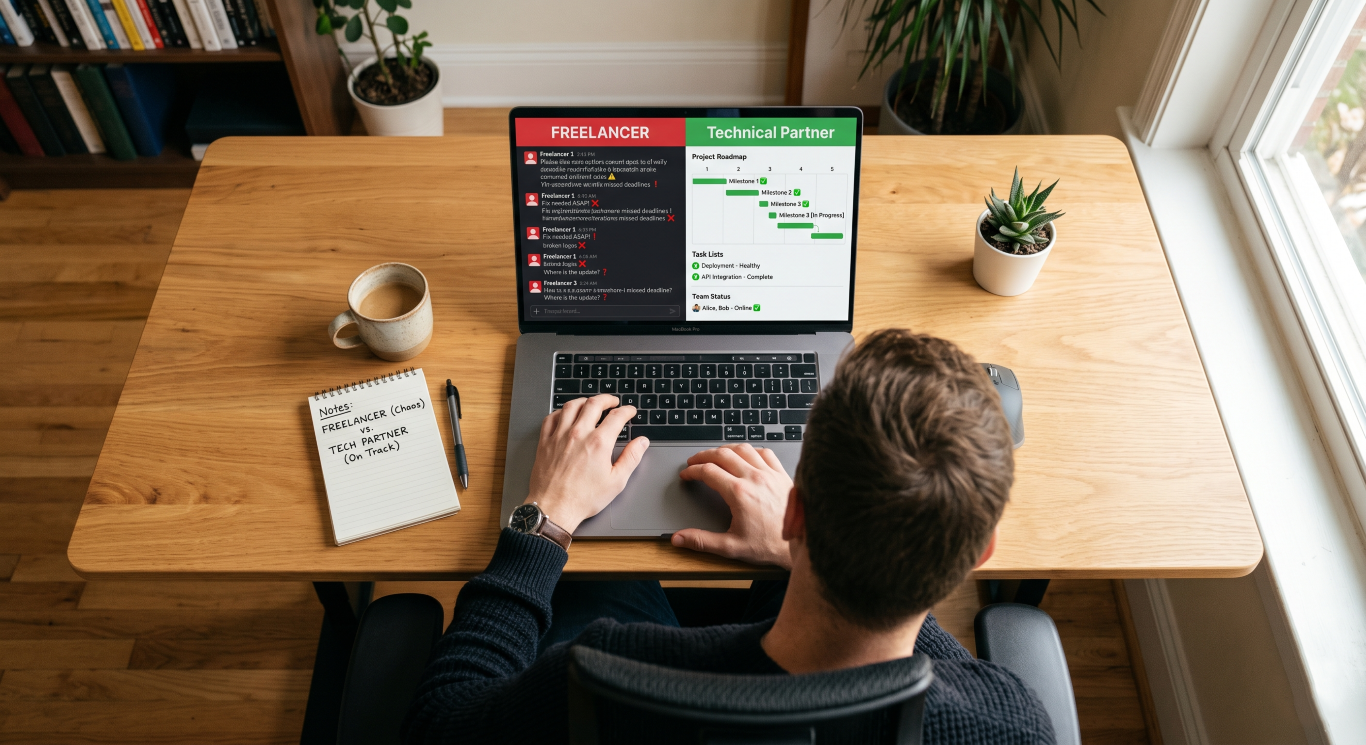
 MVP Development