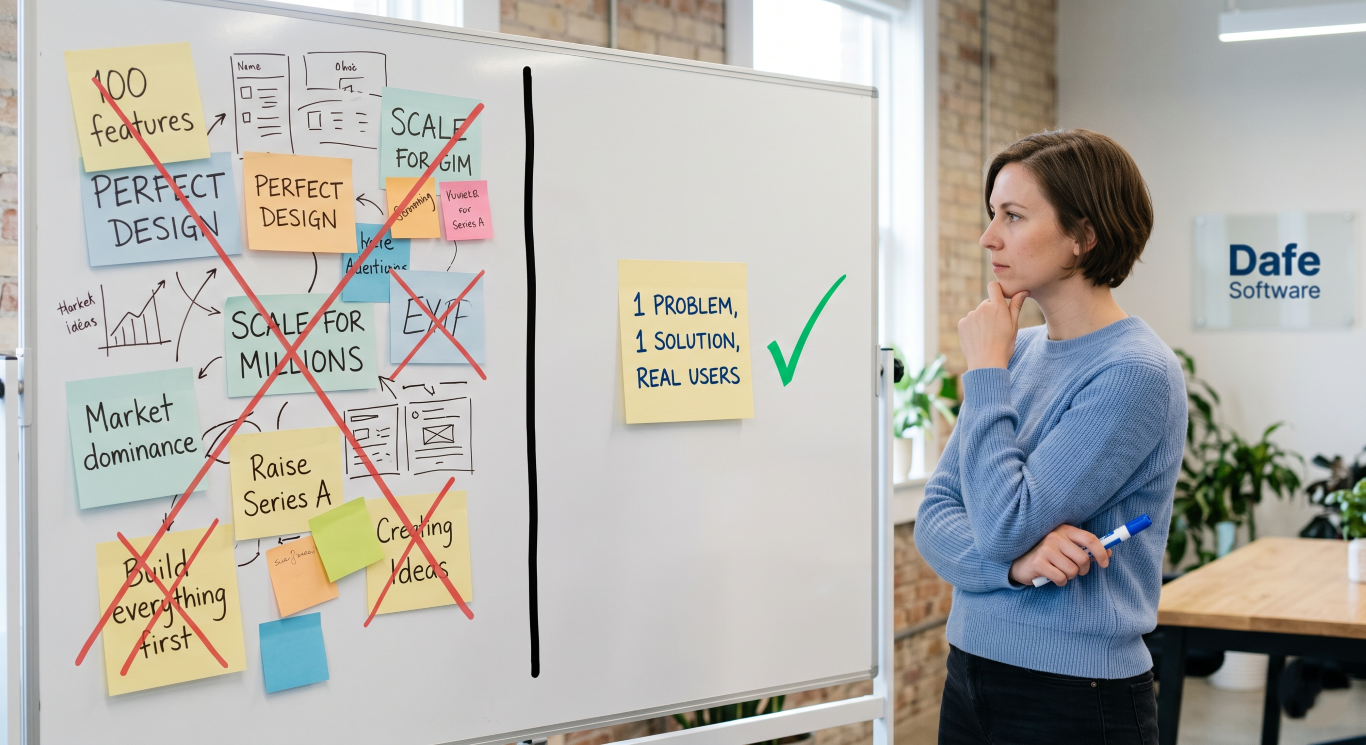
Every founder I talk to in 2026 is asking the same question, just dressed up differently. Should I build the small thing now, or should I wait until the product is "ready"? The honest answer is that most teams are still getting this decision wrong, and it is costing them more time, money, and momentum than ever before.
The reason is simple. The tools to build have never been cheaper or faster. AI-assisted development, no-code platforms, modular backend services, and same-day deployment pipelines have crushed the time it takes to put something real in front of a real user. But that speed has also blurred a line that used to be clear. Where does the MVP end and the full product begin?
This is the question we work through every week at Dafe Software with founders across SaaS, fintech, edtech, healthtech, and consumer apps. Here is how we think about it, and how you should too.
What an MVP Actually Means in 2026
The original idea of a Minimum Viable Product came from Eric Ries and his Lean Startup framework. The point was never to ship something ugly. The point was to ship the smallest thing that lets you learn something true about your users.
In 2026, that definition still holds. What has changed is the bar for "minimum." Users today expect AI features, responsive design, secure authentication, and at least one integration with the tools they already use. A stripped-down landing page with a waitlist is no longer enough to validate a real product idea. Your MVP needs to do one thing, do it well, and feel like a product someone would actually pay for.
That does not mean you build everything. It means you build the single most important loop in your product. Then you ship it.
Why Founders Still Get This Wrong
The two failure modes are well known but still common.
The first is building too much. A founder spends nine months on a "complete" product that nobody asked for, runs out of runway, and realizes their core assumption was wrong. By then, pivoting costs more than starting over.
The second is staying in MVP mode forever. The product works, users like it, revenue is starting to come in, but the founder keeps treating the product like an experiment. They never invest in scale, never harden the infrastructure, never expand the feature set, and one day a competitor with a real product arrives and eats the market.
Both failures come from the same place. Founders treat MVP versus full product as a binary, when it is actually a spectrum and a series of decisions you make based on signals.
When to Ship an MVP
You should still be in MVP mode if any of these are true.
Your core hypothesis is unproven. You think users will pay for X, but no one has paid yet. You think the workflow saves time, but you have not measured it. Until your main bet is validated by paying customers or strong qualitative signals, every feature you build is a guess stacked on top of a guess.
You have less than six months of runway. Speed matters more than polish. A working MVP in six weeks beats a polished product that ships after you have run out of money.
You are still discovering your real users. Sometimes the people who said they would buy are not the people who actually buy. An MVP lets you find your real audience instead of the audience you imagined.
The market is moving fast and a competitor could ship first. In 2026, with AI-native products launching weekly, being second can be fatal in a winner-take-most category.
You want to test pricing. The fastest way to know if your pricing works is to ask people to pay. An MVP with a real checkout flow tells you more in a week than a survey tells you in a quarter.
When to Scale to a Full Product
You should be moving past MVP if these signals are showing up.
Users are paying repeatedly and telling their friends. Retention is the strongest signal you will ever get. If customers are renewing, expanding usage, and referring others without you nudging them, the product has found something real.
You are turning away revenue because the product cannot handle it. This is a high-class problem, but it is still a problem. If enterprise prospects are walking because you lack SSO, audit logs, or a proper admin panel, you are leaving money on the table that you cannot recover later.
Your support load is climbing because of missing features, not bugs. When users keep asking for the same three things and you keep telling them "soon," your MVP has finished its job. Time to build a real product.
You have validated the unit economics. You know what it costs to acquire a customer, what they are worth over their lifetime, and the ratio works. Now scaling is no longer a gamble. It is a multiplication problem.
Investors or partners are asking about your roadmap. When external stakeholders want to know where the product is going, they are signaling that they see something worth investing in. That is the moment to upgrade from "experiment" to "company."
The Real Cost of Choosing Wrong
Building too much too early has predictable consequences. You burn cash on features no one uses. You create technical debt around assumptions that turn out to be wrong. You exhaust your team. You miss your window.
Staying in MVP mode too long has its own price. You lose deals to competitors who look more mature. You build a reputation as "the buggy one." Your best engineers leave because they want to build something serious. Your customers churn because the product never quite delivered on the promise.
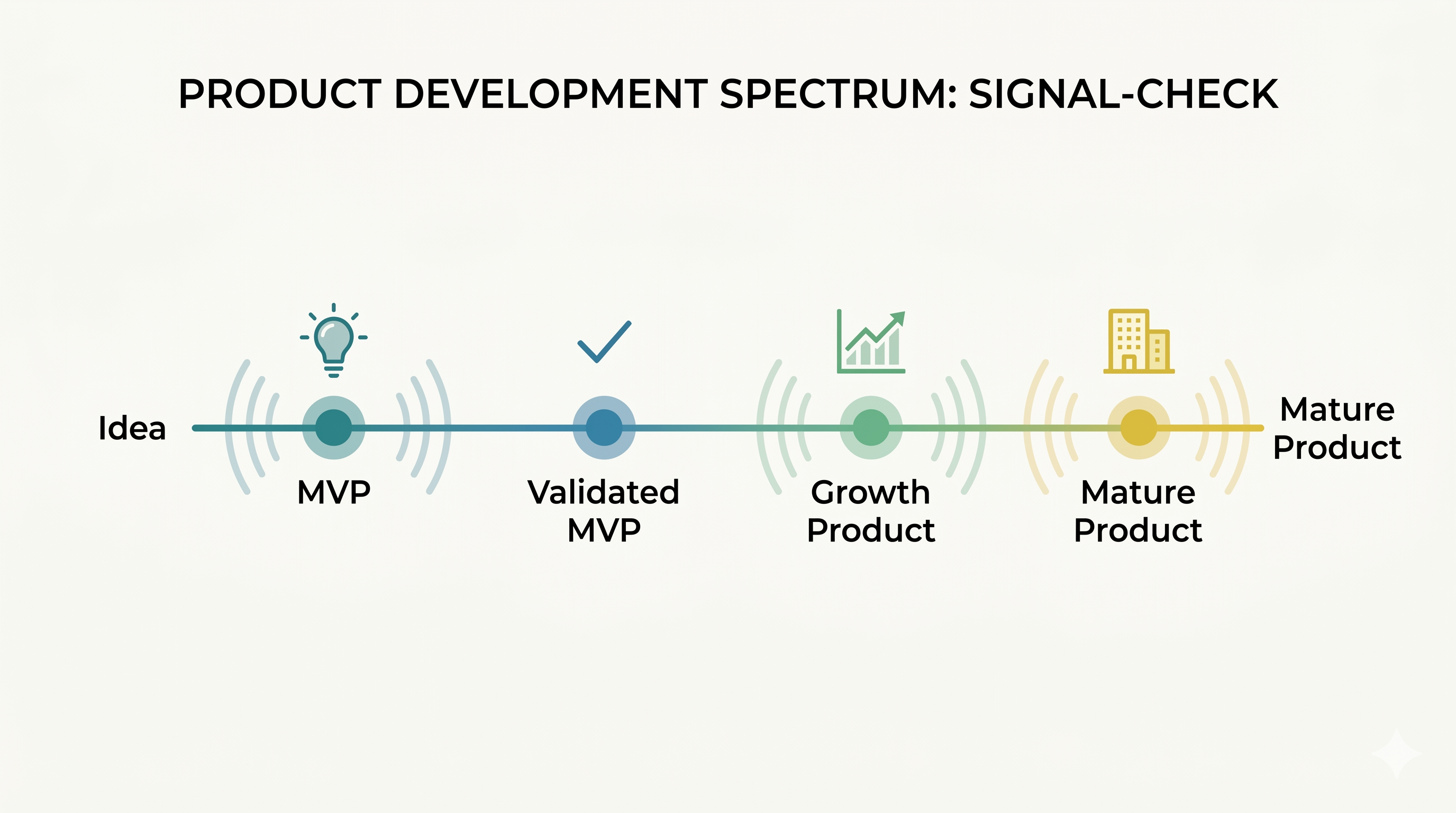
The teams that get this right do not just decide once. They keep checking the signals every quarter, sometimes every month, and they move in stages. MVP, then validated MVP, then growth product, then mature product. Each stage has different goals, different metrics, and a different shape of team.

The 2026 MVP Stack
The way we build MVPs at Dafe Software has changed dramatically in the past two years. AI-assisted coding lets us ship in days what used to take weeks. Modular backends like Supabase, Convex, and serverless platforms remove most of the infrastructure setup. Modern frontends with Next.js, Expo for mobile, and component libraries with built-in accessibility mean the product feels polished from day one.
For an MVP in 2026 we typically include user authentication, one paid plan with a real checkout, the single most important workflow built end to end, analytics that measure activation and retention, and basic AI features where they make the workflow noticeably better. That is it. No admin dashboard, no integrations marketplace, no advanced settings panel. Those come later when usage justifies the cost.
The shift in 2026 is not that MVPs are smaller. It is that MVPs are sharper. They look and feel like real products because the tools to make them feel real have become accessible to every team.
A Quick Way to Decide Right Now
If you are reading this and trying to figure out which side you are on, here is a simple test we use with founders.
Write down the one assumption your business depends on most. The thing that if it turns out to be wrong, nothing else matters. If you cannot prove that assumption is true with your current product, you are still in MVP territory, no matter how much you have built. If you can prove it, with paying customers and real retention data, then you are ready to scale.
Most founders skip this exercise because the answer is uncomfortable. But the founders who do it consistently are the ones who build companies that last.
Lessons From the Greats
Airbnb shipped a single-city air mattress listing page before they were a global brand. Dropbox launched with a demo video before they had a working sync engine. Stripe started with seven lines of code and one developer-friendly checkout. None of these teams waited until the product was "ready." They shipped, learned, and scaled with intention.
What separated them from teams that failed was not the size of the first launch. It was the discipline to ship the smallest thing that taught them something true, and the courage to invest in the full product the moment the signals lined up.

How Dafe Software Helps Founders Get This Right
At Dafe Software we specialize in MVP development for founders who need to move fast without compromising on quality. We have built MVPs that secured pre-seed funding, validated new product lines for existing companies, and shipped to thousands of users within weeks of starting. Then we walk with our clients through the next stage, scaling those MVPs into mature products when the signals say it is time.
If you are sitting on an idea and you are not sure whether to ship now or wait, you are not alone. That is the most common email in our inbox. The answer is almost always the same. Ship the smallest version that proves your biggest assumption. Then come back and build the rest.
If you want help figuring out what that smallest version looks like for your product, book a free MVP scoping call with our team at Dafe Software. We will map your core loop, identify what to cut, and give you a realistic plan to get to a real user in weeks, not quarters.
The founders who win in 2026 are not the ones with the biggest plans. They are the ones who ship the right thing at the right time. Make sure that is you.
 By
By 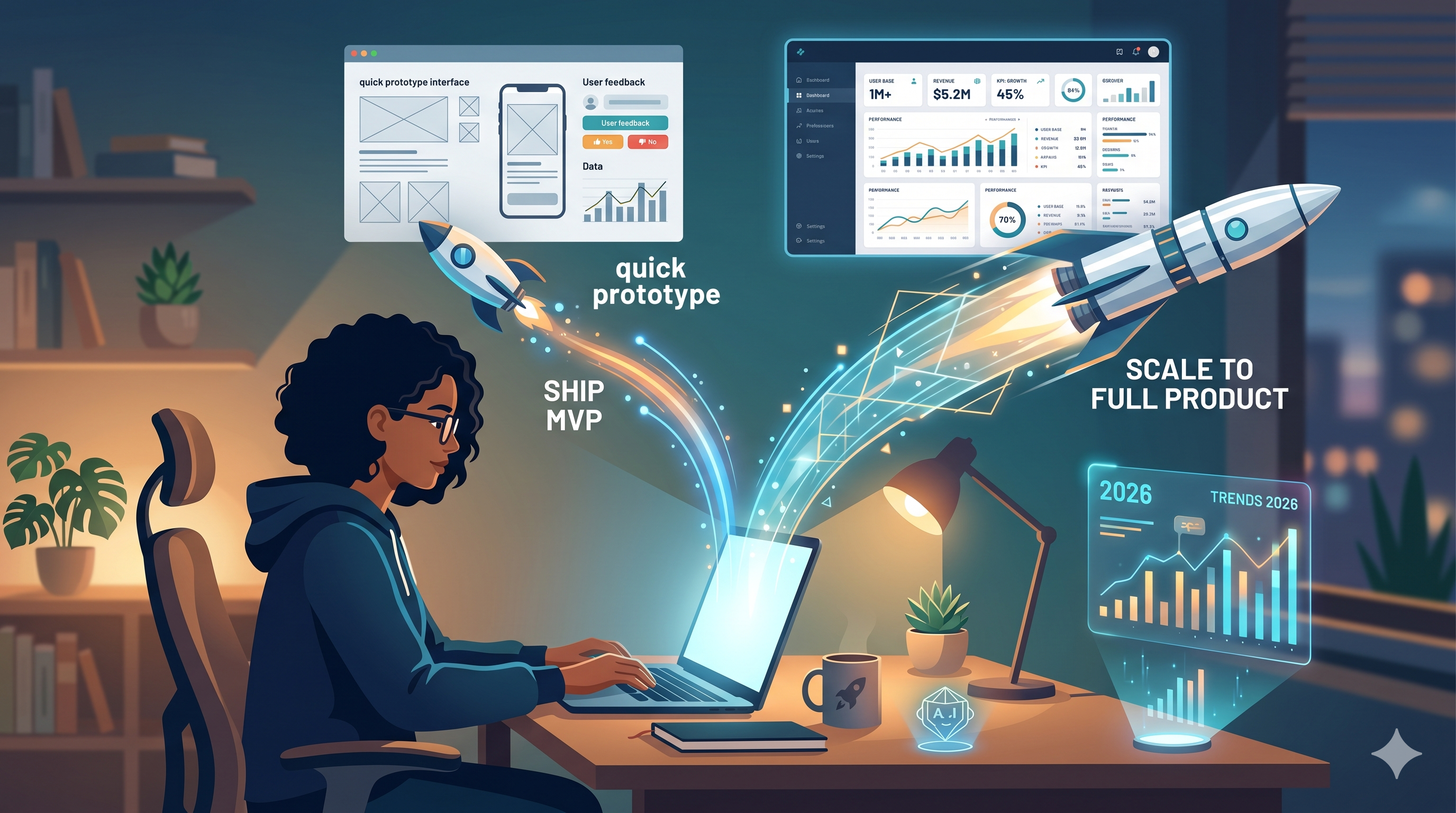
 MVP Development